Thursday, 31 December 2015

Mushrooms are Never Out of Season

Snowflake sprinkled Winter Mushrooms (Flammulina velutipes)
Photo: Mark Conboy

My mother finds some of the most interesting Christmas cards you can imagine. Among the hundreds she's stuck to our family's gifts over the years is one that sticks in my mind: an absurd illustration of a huge red and white Fly Agaric (Amanita muscaria) mushroom protruding from a thick blanket of snow and surrounded by various happy and jolly wintry creatures. I wish I still had that card, just for the laughs it brought me. Fly Agarics don't grow in the winter, at least not where I live, but there is one species that does. My interest in this species was peaked yesterday afternoon when I found a cluster growing on a decrepit old Heart-leaved Willow (Salix cordata).

The wild form of this mushroom is variously called Winter Mushroom, Black Foot, Velvet Foot, Velvet Stem, Velvet Stalk, Velvet Shank, or Seafood Mushroom. There's also a domestic form that goes by a different suite of names: Golden Needle Mushroom, Lily Mushroom, Enoki, and perhaps most popularly, Enokitake. Either way, all names refer to Flammulina velutina, and its the only species of mushroom that regularly fruits in winter. Winter Mushrooms can grow in colder weather than most other species, in part because they have proteins that bind to ice, lowering the freezing point, reducing the chances of cell damage in moderately cold temperatures.

The domestic form of the Winter Mushroom (Flammulina velutipes)
Photo: Chris 73 (Wikimedia Commons)

By comparison to the wild type (top photo), the form of Winter Mushroom that can be purchased in grocery stores and Chinatowns, usually called Enotitake, is almost unrecognizable. Enotitake is one of the most commonly cultivated fungi species in the world. They're grown in darkness, so the mushrooms don't develop any pigments. They're also grown in a CO2-rich environment, which causes the mushrooms to take on a long, thin habit and develop only small button-like caps. Yes, the wild form is edible too, but use caution not to confuse it with other late-fruiting wood-dwelling mushrooms, such as Deadly Galerina (Galerina autumnalis) and its congeners. Needless to say, you don't want to eat Deadly Galerina; expert advice and a good field guide are absolutely necessary when identifying edible mushrooms.

Tuesday, 29 December 2015

BioBrevia: Smallest of the Small

This shot of a Buprestis striata is indeed macro, but the Nikon Small World
Photomicrography Competition takes it to a whole new level.
Photo: Mark Conboy

The winners of the 2015 Nikon Small World Photomicrography Competition have been announced. The winner was Ralph Grimm's shot of a pollen-laced European Honey Bee (Apis mellifera) eye. Check out these stunning images. While you're at it, also check out the Small World in Motion Competition. The winner was Wim van Egmond's video of two ciliate protozoans: a Trachelius sp. depredating a Campanella sp.

BioBrevia: Going Deep

Lake Erie's east basin
Map: CHS/NOAA

I live on the north shore of Lake Erie. I watch its water levels rise and fall, its storms rage and subside. I boat hundreds of kilometres on its surface in the course of a year. I watch the migratory birds, butterflies and dragonflies swarm along Long Point every spring and fall. I swim on its wonderful sandy beaches. I'm intrigued by all aspects of Lake's Erie's natural history and geography. To that end, I've enjoyed this set of bathymetry maps from the Canadian Hydrographic Service, the National Oceanic and Atmospheric Administration (NOAA)  National Geophysical Data Center's Marine Geology and Geophysics Division, and the NOAA Great Lakes Environmental Research Laboratory.

Sunday, 27 December 2015

BioBrevia: National Birds of the World

Hoatzin (Opisthocomus hoazin)
Photo: Philina English

Canadian Geographic has put together a map showing some national birds from around the world. A surprising number of countries, including Canada, don't have officially recognized national birds, but are in the process of selecting one. Unfortunately, the map doesn't stick to the conventional names that most of us are used to. It has the United States' bird labelled as American bald eagle, which isn't a real species name; simply, Bald Eagle (Haliaeetus leucocephalus) is correct. Most birders will know Cuba's national bird, not as the tocororo, but as the Cuban Trogon (Priotelus temnurus), but only the former name is given. And there are no scientific names with which to cross-reference the other obscure local or colloquial names like cahow (Bermuda Petrel [Pterodroma cahow]) or Canje pheasant (Hoatzin [Opisthocomus hoazin]). It's an interesting map, nonetheless.

Friday, 25 December 2015

In Praise of the Freshwater Drum

Freshwater Drum (Aplodinotus grunniens)
Illustration: WPClipart

I wish to say a few words about an odd fish, the Freshwater Drum (Aplodinotus grunniens). Here's a species that I too seldom see alive, but I do find washed up dead, on the shores of Lake Erie with some regularity. Indeed, just this evening I watched a Great Black-backed Gull (Larus marinus) rip apart a smoldering drum carcass, its heavy bill effortlessly shearing the hard overlapping ctenoid scales that smaller scavengers like Ring-billed Gulls (Larus delawarensis) would have had difficulty penetrating. As fascinating as is the process of death and decay, it's the living Freshwater Drum that I'm here to endorse.

A drum's thick scales help protect it from attack by the parasitic native Silver Lamprey (Ichthyomyzon unicuspis) and the highly invasive non-native Sea Lamprey (Petromyzon marinus). Using suction cup-like mouths, lampreys attach themselves to large fish, chewing through their host's scales to the soft tissue below, using a toothed tongue. A lamprey feeds on the blood of its host, sometimes for months at a time. This can be severely detrimental to the host, resulting in reduced reproductive success, or ultimately even death. Freshwater Drum enjoy the advantage of being a among the most well-armored Great Lakes fish, a significant advantage in a world teaming with raspy-tongued parasites.

Besides their boilerplate scales, drum are oddballs among Great Lakes fish for other reasons, and their name, Freshwater Drum, makes it plain. This is the only species of totally freshwater-dwelling drum. All of the other 160 or so drums and croakers (family Sciaenidae) are marine. No other native Great Lakes fish has such a salty pedigree, though the Burbot (Lota lota) comes close, with only one other member of the cod family (Gadidae) found in freshwater - the Atlantic Tomcod (Microgadus tomcod). The name drum, and the specific moniker grunniens, which means "grunting", refers to the sounds that this species makes during mating, and, indeed, when handled by anglers. Drums don't vocalize in the conventional way most mammals or birds do, by issuing vibrations in the throat, instead their sounds are produced by muscular manipulating of the swim bladder. As far as I know, this is the only Great Lakes fish that makes sounds.

Freshwater Drum eggs contain a large oil globule that allows them to float on the water's surface, something totally unique among North American freshwater fish. Most other freshwater fish lay their eggs in nests, like sticklebacks and sunfish, or  stick their eggs to vegetation or other debris, as Yellow Perch (Perca flavescens) do. Some ichthyologists have suggested that planktonic eggs may be particularly good at dispersing long distances, perhaps having played a role in helping Freshwater Drum to attain the greatest natural latitudinal distribution of any fish in North America; they range from the northern reaches of Manitoba's mighty Nelson River to southern Mexico and Guatemala.

From a simple examination of a fish's mouth, it's possible to hypothesize something about its foraging ecology. For example, a Brook Silverside (Labidesthes sicculus) sports an upturned mouth for taking surface-dwelling prey, and don't forget the aforementioned parasitic lampreys with their suctioning and rasping mouthparts. Silversides and lampreys have highly modified external mouthparts, and while Freshwater Drums have extraordinary internal mouth parts. They're highly adapted for crushing the shells of hard-bodied prey. Most perciform fish have two sets of jaws, the external ones which we can plainly see, and a set of internal ones, and it's a drum's internal ones, the pharyngeal jaws, that set them apart. Drum pharyngeal arches are unique among Great Lakes fish in that they are fused together and are covered with large molar-like teeth, adaptations for processing hard foods, namely mollusks and crayfish. No other fish in the Great Lakes has such highly modified arches, though some other species, like Pumpkinseed (Lepomis gibbosus) and Yellow Perch, do feed on mollusks, they don't have the same crushing adaptations. Drums grind native and non-native mollusks, alike, including Zebra (Dreissena polymorpha) and Quagga Mussels (Dreissena bugensis), on those molar-like teeth using powerful muscles which are supported by a series of bone struts on their robust skulls.

Once in a while, while wandering along the beach, I find a polished and intact drum arch washed up on shore, a reminder that there is a thick-scaled, croaking, planktonic egg-laying, mussel-crushing, freshwater version of a marine fish, beneath the Lake Erie waves. Fascinating!

Wednesday, 23 December 2015

BioBrevia: X-rayted Natural History

X-ray and schematic illustrations of the critically endangered Montserrat Galliwasp (Diploglossus montisserrati) and shell fragments of its prey, a freshwater snail (Omalonyx matheroni).
Imagery: Bohaton et al 2015 (Creative Commons Attribution 4.0)

A new paper in Royal Society Open Science by Bochaton et al, X-ray Microtomography Provides First Data About the Feeding Behaviour of an Endangered Lizard, the Montserrat Galliwasp (Diploglossus montisserrati), is certainly a novel investigation of lizard diets. The Montserrat Galliwasp is one of the rarest reptiles on Earth, so rare that decades pass between observations of it in the wild, and it has only found its way into museum collections twice. This is an interesting article; here's the abstract:

Reporting the diet of recently extinct or very rare taxa, only known by a few museum specimens, is challenging. This study uses X-ray microtomography, a non-destructive investigation method, to obtain the first data about feeding behaviours in the Montserrat galliwasp (Diploglossus montisserrati) by scanning one of the two specimens known to date. The scans revealed the occurrence of shell fragments of a freshwater snail (Omalonyx matheroni) in the digestive tract of the specimen. This data combined with morphological evidence shows the occurrence of a durophagous feeding habit and a possible tendency of association with freshwater environments. This information could be crucial to save this critically endangered lizard endemic on Montserrat island. (Reproduced under Creative Commons Attribution 4.0).

Sunday, 20 December 2015

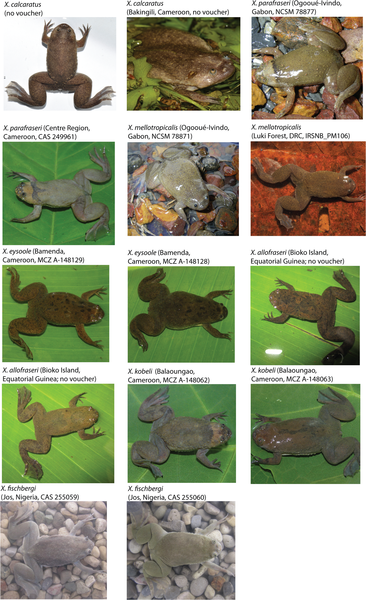
BioBrevia: New Clawed Frogs from Africa

New and "resurrected" species of clawed frogs.
Photos: From Evans et al 2015. Creative Commons Attribution 4.0.

Here's a new article in PLOS ONE, by Evans et al., with the descriptive title: Genetics, Morphology, Advertisement Calls, and Historical Records Distinguish Six New Polyploid Species of African Clawed Frog (Xenopus, Pipidae) from West and Central Africa. This paper deals much more with the nuances of genetics and systematics than the natural history of the frogs themselves. It is a great illustration of just how complex the diagnoses of species can be. Here's the abstract:

African clawed frogs, genus Xenopus, are extraordinary among vertebrates in the diversity of their polyploid species and the high number of independent polyploidization events that occurred during their diversification. Here we update current understanding of the evolutionary history of this group and describe six new species from west and central sub-Saharan Africa, including four tetraploids and two dodecaploids. We provide information on molecular variation, morphology, karyotypes, vocalizations, and estimated geographic ranges, which support the distinctiveness of these new species. We resurrect Xenopus calcaratus from synonymy of Xenopus tropicalis and refer populations from Bioko Island and coastal Cameroon (near Mt. Cameroon) to this species. To facilitate comparisons to the new species, we also provide comments on the type specimens, morphology, and distributions of X. epitropicalis, X. tropicalis, and X. fraseri. This includes significantly restricted application of the names X. fraseri and X. epitropicalis, the first of which we argue is known definitively only from type specimens and possibly one other specimen. Inferring the evolutionary histories of these new species allows refinement of species groups within Xenopus and leads to our recognition of two subgenera (Xenopus and Silurana) and three species groups within the subgenus Xenopus (amieti, laevis, and muelleri species groups). (Reproduced under Creative Commons Attribution 4.0).

Cave Swallow Express

Cave Swallow (Petrochelidon fulva)

One of my favourite walking routes is a 5 km stretch of Lake Erie coast, along beaches, over dunes, past wetlands and scrubby bush, which even in December, can produce a good diversity of birds, including fantastic counts of waterfowl. Sometimes, this walk offers up a particularly nice surprise, like the one that came in the form of three Cave Swallows (Petrochelidon fulva), just the other day. Cave Swallows are rare in Ontario, but they do occur nearly every autumn, and the reasons behind their late-season appearance are still a little unclear, but is a probably a combination of factors, including far-ranging weather systems, population ecology and life history traits.

Usually, Cave Swallows begin to appear in Ontario in late October through November, with some birds lingering (or even arriving) as late as December, when the weather allows. Almost all of Ontario's records are from the north shores of Lakes Erie and Ontario, with a few scattered observations elsewhere. Movements into Ontario seem to be almost invariably preceded by strong southerly winds, sometimes in the form of hurricanes and tropical storms, or as more subdued systems which channel warm air out of the southern United States and into the Great Lakes basin. In late fall and even early winter, when southern winds are blowing, it's time to start looking for Cave Swallows. It's not just Ontario that receives these apparent reverse migrations of swallows, the southern Atlantic states, for example, also experience such events.

But why is it the Cave Swallow, of all the possible species, that gets blown north each fall? There are likely a number of factors at work, the first being the phenomenal population increase this species has undergone in Texas since its first breeding record in 1915. Texas's Cave Swallows have increased their breeding range by an estimated 898% since 1957, with concomitant increases in the numbers of both breeding and overwintering birds, particularly in the 1990's. Ontario records may reflect the assent of Cave Swallows, to some degree; the first record of Cave Swallows in Ontario was in 1989, and near-annual autumn movements began in 1998. Species that experience such explosive population growth and range expansion, also seem to be most prone to producing vagrants, in part because young birds may be disperse widely in search of new, less densely populated breeding sites.

There are also life history traits that may mean Cave Swallows are particularly good candidates for vagrancy. Being aerialists, swallows are more likely than other birds, to be sucked into weather systems. Because they are such gifted fliers, Cave Swallows could potentially ride systems longer than other species, which may need to drop out to rest before reaching the Great Lakes. That's not to say that other species don't arrive as vagrants in association with the same kinds of weather patterns that bring the swallows. Currently, there is a western flycatcher (Empidonax sp) in Ohio, and a Vermilion Flycatcher (Pyrocephalus rubinus), a Bullock's Oriole (Icterus bullockii) and a couple of Mountain Bluebirds (Sialia currucoides) in Ontario, plus a Black-throated Grey Warbler (Setophaga nigrescens) in western Quebec. These species could have all been brought north on the same weather systems that have been shuttling Cave Swallows into the Great Lakes basin this fall. Birders should use Cave Swallows as an alert system: when the Cave Swallow Express rolls in, there may other rarities on board.

Friday, 18 December 2015

BioBrevia: New Birding Record

Rufous Motmot (Baryphthengus martii)
Photo: Philina English

A team of birders in Ecuador has established a new world record: they've seen 431 species of birds in 24 hours, that's more than any other team has managed in a single day! George Paul has put together a nice article about this record (with more to come) and the history of the Global Big Day on the American Birding Association blog.

Thursday, 17 December 2015

BioBrevia: Ancient Aesthetics

Han Shan
Illustration: Yan Hui

Ever since I discovered Gary Snyder's and Bill Porter's (aka Red Cloud) translations of the hermit-poet Han Shan's esoteric works, I've had a fascination with the natural imagery and aesthetics of ancient Chinese poetry. Or, at least the English translations of it. Here's a short a piece from Orion that won't be lost on fans of this remarkable art form.