Showing posts with label Research. Show all posts

Thursday, 15 June 2017

Banding One Millions Birds

A Gambel's White-crowned Sparrow (Zonotrichia leucophrys gambelii) and an Eastern White-crowned Sparrow (Z. l. leucophrys).
Photo: Long Point Bird Observatory

Here is a recent article I wrote for BirdWatch Canada, a publication of Bird Studies Canada. This spring, Long Point Bird Observatory, for which I am the Program Coordinator, banded its one millionth bird, an milestone that no other Western Hemisphere bird observatory has yet reached. This article was part of a lead up to that event.

Friday, 24 February 2017

Long Point Bird Observatory 2016 Year End Report


The first Barred Owl (Strix varia) ever banded at Long Point Bird Observatory was captured in 2016.
Photo: Terren (Wikimedia Commons)


In 2016 Long Point Bird Observatory (LPBO), the oldest bird observatory in the western hemisphere, completed its 58th migration monitoring season. LBPO banded 44,612 birds last year. Additionally 5,419 recaptures of previously banded birds were processed. The first Barred Owl ever banded at LPBO was captured during the fall season. Other notable banding records included the eighth ever Broad-winged Hawk (the first since 2006), the fourth ever Painted Bunting and record high banding totals for:

· Cliff Swallow, 22 (previous record was 13 in 1982);
· Oregon Junco, three (single birds banded in six previous years)
· Red-eyed Vireo, 496 (previous record was 490 in 2012);
· Summer Tanager, four (tied with 2009);
· Tufted Titmouse, five (previous record was four in 2005);
· Warbling Vireo, 162 (previous record was 143 in 2014); and
· Yellow Palm Warbler, six (tied with 2005).

Despite these highlights, LPBO banded the fewest birds since 2004. Last year, LPBO banded 15.5% (4,498 individuals) fewer birds than the previous 10-year average. The story was no better for the number of species and forms, with 2016 again being the lowest total since 2004. The 141 species and forms captured in 2016 was about 10% (16 species) below the previous 10-year average.

The complete 2016 Year End Report can be found here.

Friday, 22 July 2016

BioBrevia: Microscopic Ménages à Trois

A new and startling discovery shows that hitherto undiscovered yeasts may be part of some lichens.
Photo: Mark Conboy

In a refreshingly good piece of science journalism from the Canadian Broadcasting Corporation, Emily Chung reports on the shocking discovery that some Bryoria lichens contain yeast, in addition to their photobioant (an algae and/or cyanobacteria) and known fungal component. How this went unnoticed for more than century is almost unbelievable; so not surprisingly, not all lichenologists are completely convinced yet. The full paper was published in Science, but you'll have to pay to read it.

Thursday, 21 July 2016

BioBrevia: Ancient Things Incredible

Some Trembling Aspen (Populus tremuloides) colonies in the Rocky Mountains are thousands of years old.
Photo: Mark Conboy

Check out this fascinating Ted Talk by Rachel Sussman on some of the world's oldest, and incidentally, weirdest, organisms. From the otherworldly Welwitschia mirabilis whose two massive leaves are never shed, even after centuries of growth, to the ridiculously ancient actinobacteria that remain active even in the coldest conditions of the Siberia tundra, it will blow your mind to meet some of the oldest organisms we share our little blue planet with!

Wednesday, 20 July 2016

BioBrevia: Comprehending Cuckoos

A victim of brood parasitism, an Eurasian Reed Warbler (Acrocephalus scirpaceus) feeds a Common Cuckoo (Cuculus canorus) nestling. The decline of Common Cuckoo means that this behaviour is becoming less common across Europe.
Photo: Per Harald Olsen (Wikimedia Commons)

A new paper in Nature Communications, Population Decline is Linked to Migration Route in the Common Cuckoo, by Hewson et al shows that Common Cuckoos (Cuculus canorus) take two different routes from Europe to their African wintering grounds during autumn migration. The researchers used satellite telemetry to track birds in virtually real time as they made their way south. The data showed that birds which took the shorter route experienced higher mortality rates than birds that took the longer route. This differential mortality correlated to population declines on the British breeding grounds. It's further evidence that effective conservation of migratory birds must take into account migration ecology as much as breeding and wintering site ecology.

Tuesday, 15 March 2016

BioBrevia: Climate Lessons from the Deep

A Stoplight Parrotfish (Sparisoma viride) crunches coral.
Photo: Sarah Larocque

Here's a newly posted TEDx talk by marine chemist Laura Robinson. She speaks on what fossilized corals can reveal about climate oscillations from Earth's past and how we might use that knowledge today in our own fight against climate change.

Sunday, 13 March 2016

BioBrevia: Good News from Black-faced Spoonbill Country

Black-faced Spoonbill (Platalea minor)
Photo: Cp9asngf (Wikimedia Commons)

BirdLife International is reporting that a recent annual census of the globally endangered Black-faced Spoonbill (Platalea minor) was a record breaker! Counters from across East Asia counted a record-high 3,356 birds. A record-high count yes, but its a matter of perspective, of course. The global population of spoonbills is still dangerously small, and despite the count, the species has declined significantly in some of its traditionally important wintering sites, such as China's Mai Po Nature Reserve. Read more on the spoonbill and the census.

Monday, 4 January 2016

BioBrevia: Introducing the Ninja Lanternshark

The newly described Ninja Lanternshark (Etmopterus benchleyi)
Photo: From Vasquesz et al 2015

A new species of lanternshark, whimsically named the Ninja Lanternshark (Etmopterus benchleyi), has been described in a paper by Vasquez et al in the Journal of the Ocean Science Foundation. Like the lanternsharks I've written about previously, the Ninja Lanternshark can glow, but it seems to have only a limited number of photophores.

Wednesday, 23 December 2015

BioBrevia: X-rayted Natural History

X-ray and schematic illustrations of the critically endangered Montserrat Galliwasp (Diploglossus montisserrati) and shell fragments of its prey, a freshwater snail (Omalonyx matheroni).
Imagery: Bohaton et al 2015 (Creative Commons Attribution 4.0)

A new paper in Royal Society Open Science by Bochaton et al, X-ray Microtomography Provides First Data About the Feeding Behaviour of an Endangered Lizard, the Montserrat Galliwasp (Diploglossus montisserrati), is certainly a novel investigation of lizard diets. The Montserrat Galliwasp is one of the rarest reptiles on Earth, so rare that decades pass between observations of it in the wild, and it has only found its way into museum collections twice. This is an interesting article; here's the abstract:

Reporting the diet of recently extinct or very rare taxa, only known by a few museum specimens, is challenging. This study uses X-ray microtomography, a non-destructive investigation method, to obtain the first data about feeding behaviours in the Montserrat galliwasp (Diploglossus montisserrati) by scanning one of the two specimens known to date. The scans revealed the occurrence of shell fragments of a freshwater snail (Omalonyx matheroni) in the digestive tract of the specimen. This data combined with morphological evidence shows the occurrence of a durophagous feeding habit and a possible tendency of association with freshwater environments. This information could be crucial to save this critically endangered lizard endemic on Montserrat island. (Reproduced under Creative Commons Attribution 4.0).

Sunday, 20 December 2015

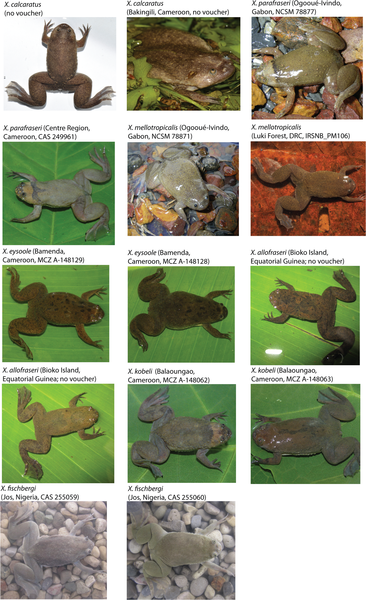
BioBrevia: New Clawed Frogs from Africa

New and "resurrected" species of clawed frogs.
Photos: From Evans et al 2015. Creative Commons Attribution 4.0.

Here's a new article in PLOS ONE, by Evans et al., with the descriptive title: Genetics, Morphology, Advertisement Calls, and Historical Records Distinguish Six New Polyploid Species of African Clawed Frog (Xenopus, Pipidae) from West and Central Africa. This paper deals much more with the nuances of genetics and systematics than the natural history of the frogs themselves. It is a great illustration of just how complex the diagnoses of species can be. Here's the abstract:

African clawed frogs, genus Xenopus, are extraordinary among vertebrates in the diversity of their polyploid species and the high number of independent polyploidization events that occurred during their diversification. Here we update current understanding of the evolutionary history of this group and describe six new species from west and central sub-Saharan Africa, including four tetraploids and two dodecaploids. We provide information on molecular variation, morphology, karyotypes, vocalizations, and estimated geographic ranges, which support the distinctiveness of these new species. We resurrect Xenopus calcaratus from synonymy of Xenopus tropicalis and refer populations from Bioko Island and coastal Cameroon (near Mt. Cameroon) to this species. To facilitate comparisons to the new species, we also provide comments on the type specimens, morphology, and distributions of X. epitropicalis, X. tropicalis, and X. fraseri. This includes significantly restricted application of the names X. fraseri and X. epitropicalis, the first of which we argue is known definitively only from type specimens and possibly one other specimen. Inferring the evolutionary histories of these new species allows refinement of species groups within Xenopus and leads to our recognition of two subgenera (Xenopus and Silurana) and three species groups within the subgenus Xenopus (amieti, laevis, and muelleri species groups). (Reproduced under Creative Commons Attribution 4.0).

Wednesday, 16 December 2015

BioBrevia: Another New Atlantic Forest Amphibian

Dendropsophus bromeliaceus
Photos: From Ferreira et al 2015 (Creative Commons Attribution 4.0)

Brazil's Atlantic Forest, which thanks to its more famous counterpart, the Amazon Rainforest, just doesn't get the attention it deserves, at least not from the general public. Luckily, the Atlantic Forest's incredible biodiversity hasn't been lost on biologists though, who continue working toward unravelling its mysteries. Not too long ago, I posted a note on the three new toad species that were described from the Atlantic Forest. All of those species were bromeligenous, that is to say they, like the Golden Rocket Frog (Anomaloglossus beebei) I've previously written about, breed in little pools of water that collect in bromeliads. A new paper in PLOS ONE by Ferreira et al, introduces yet another newly described phytotelm-breeding species from the Atlantic Forest. To meet the treefrog Dendropsophus bromeliaceus read the paper; here's the abstract, to get you started:

We describe a new treefrog species of Dendropsophus collected on rocky outcrops in the Brazilian Atlantic Forest. Ecologically, the new species can be distinguished from all known congeners by having a larval phase associated with rainwater accumulated in bromeliad phytotelms instead of temporary or lentic water bodies. Phylogenetic analysis based on molecular data confirms that the new species is a member of Dendropsophus; our analysis does not assign it to any recognized species group in the genus. Morphologically, based on comparison with the 96 known congeners, the new species is diagnosed by its small size, framed dorsal color pattern, and short webbing between toes IV-V. The advertisement call is composed of a moderate-pitched two-note call (~5 kHz). The territorial call contains more notes and pulses than the advertisement call. Field observations suggest that this new bromeligenous species uses a variety of bromeliad species to breed in, and may be both territorial and exhibit male parental care. (Reproduced under Creative Commons Attribution 4.0).

Friday, 11 December 2015

BioBrevia: Hope for the Old Fashion Field Naturalist

Illustration: Philip Henry Gosse 

This brief article from Science, Explosion in new Dragonfly Species Results in Animals Named after Gorillas, Pink Floyd, and the accompanying presentation, are great inspiration for would-be naturalist-explorers. A small team recently described 60 new species of dragonflies and damselflies from west and central Africa. All of these species were recognized in the field before they were diagnosed using genetics in the lab, demonstrating that an abundance of new species still await discovery the old fashioned way, by simply getting out in the field and knowing your stuff. The actual journal article in which the new species are described is available from Odonatologica.

Monday, 7 December 2015

BioBrevia: New Species of Toads from Brazil


Melanophryniscus biancae.
Photo: from Bornschein et al 2015 (Creative Commons Attribution 4.0) 

A newly published paper in PLOS One by Bornschein et al entitled Three New Species of Phytotelm-Breeding Melanophryniscus from the Atlantic Rainforest of Southern Brazil (Anura: Bufonidae), brings to light some exciting discoveries in a rapidly vanishing habitat. Here's the abstract:
 
Three new species of Melanophryniscus are described from the Serra do Mar mountain range of the state of Santa Catarina, southern Brazil. All species are found at intermediate to high altitudes and share phytotelm-breeding as their reproductive strategy. The new species are distinguished from other phytotelm-breeding Melanophryniscus based on different combinations of the following traits: snout-vent length, presence of white and/or yellow spots on forearms, mouth, belly and cloaca, pattern and arrangement of warts, and presence and number of corneous spines. The discovery of these species in a rather restricted geographical area suggests that the diversity of phytotelm-breeding species of Melanophryniscus might be severely underestimated. The conservation status of these species is of particular concern, given that one of them is at risk of extinction not only due to its restricted habitat, but also because of anthropogenic disturbances. (Reproduced under Creative Commons Attribution 4.0).

Saturday, 28 November 2015

BioBrevia: Of Humpbacks and Seamounts

Satellite tracks of Humpback Whales (Megaptera novaeangliae) between New Caledonia and New Zealand.
Adapted from Garrigue et al 2015 (Creative Commons Attribution 4.0) 

Here's a new article from Royal Society Open Science, Satellite tracking reveals novel migratory patterns and the importance of seamounts for endangered South Pacific humpback whales, by Claire Garrigue et al. This is the abstract:

The humpback whale population of New Caledonia appears to display a novel migratory pattern characterized by multiple directions, long migratory paths and frequent pauses over seamounts and other shallow geographical features. Using satellite-monitored radio tags, we tracked 34 whales for between 5 and 110 days, travelling between 270 and 8540 km on their southward migration from a breeding ground in southern New Caledonia. Mean migration speed was 3.53±2.22 km h−1, while movements within the breeding ground averaged 2.01±1.63 km h−1. The tag data demonstrate that seamounts play an important role as offshore habitats for this species. Whales displayed an intensive use of oceanic seamounts both in the breeding season and on migration. Seamounts probably serve multiple and important roles as breeding locations, resting areas, navigational landmarks or even supplemental feeding grounds for this species, which can be viewed as a transient component of the seamount communities. Satellite telemetry suggests that seamounts represent an overlooked cryptic habitat for the species. The frequent use by humpback whales of such remote locations has important implications for conservation and management. (Reproduced under Creative Commons Attribution 4.0).

Friday, 27 November 2015

BioBrevia: Death by Water

European Starling (Sturnus vulgaris)
Photo: NatJLN (Wikimedia Commons)

A new article by Lawson et al, Drowning is an apparent and unexpected recurrent cause of mass mortality of Common starlings (Sturnus vulgaris), in Science Reports is an interesting piece of macabre natural history. Here's the abstract:

Drowning is infrequently reported as a cause of death of wild birds and such incidents typically involve individual, rather than multiple, birds. Over a 21-year period (1993 to 2013 inclusive), we investigated 12 incidents of mortality of multiple (2 − 80+) Common starlings (Sturnus vulgaris) in Great Britain that appeared to be due to drowning. More than ten birds were affected in ten of these reported incidents. These incidents always occurred during the spring and early summer months and usually involved juvenile birds. In all cases, circumstantial evidence and post-mortem examinations indicated drowning to be the most likely cause of death with no underlying disease found. A behavioural explanation seems likely, possibly related to the gregarious nature of this species combined with juvenile inexperience in identifying water hazards. A review of data from the ringed bird recovery scheme across Great Britain (1909–2013 inclusive) of both starlings and Common blackbirds (Turdus merula), also a common garden visitor, identified additional suspected drowning incidents, which were significantly more common in the former species, supporting a species predisposition to drowning. For each species there was a marked seasonal peak from April to August. Drowning should be included as a differential diagnosis when investigating incidents of multiple starling mortality, especially of juveniles. (Reproduced under Creative Commons Attribution 4.0).

Friday, 20 November 2015

BioBrevia: Dancing Duetters

Blue-capped Cordon-bleu (Uraeginthus cyanocephalus) dance steps.
Adapted from Ota et al 2015 (Creative Commons Attribution 4.0)
 

A brand new article by Ota et al, entitled Tap dancing birds: the multimodal mutual courtship display of males and females in a socially monogamous songbird, appeared yesterday in Scientific Reports. Here's the abstract:

According to classical sexual selection theory, complex multimodal courtship displays have evolved in males through female choice. While it is well-known that socially monogamous songbird males sing to attract females, we report here the first example of a multimodal dance display that is not a uniquely male trait in these birds. In the blue-capped cordon-bleu (Uraeginthus cyanocephalus), a socially monogamous songbird, both sexes perform courtship displays that are characterised by singing and simultaneous visual displays. By recording these displays with a high-speed video camera, we discovered that in addition to bobbing, their visual courtship display includes quite rapid step-dancing, which is assumed to produce vibrations and/or presumably non-vocal sounds. Dance performances did not differ between sexes but varied among individuals. Both male and female cordon-bleus intensified their dance performances when their mate was on the same perch. The multimodal (acoustic, visual, tactile) and multicomponent (vocal and non-vocal sounds) courtship display observed was a combination of several motor behaviours (singing, bobbing, stepping). The fact that both sexes of this socially monogamous songbird perform such a complex courtship display is a novel finding and suggests that the evolution of multimodal courtship display as an intersexual communication should be considered. (Reproduced under Creative Commons Attribution 4.0).